
enVista Envy™
Full Range of Vision IOLs
enVista Envy™ is designed to support a full range of vision with performance that helps surgeons address today’s cataract patient expectations with confidence.1

Flourish At Every Step
Discover the full range of vision IOL that launches a new era of confidence with enviable outcomes1
Full Range of Vision Correction →
Excellent Performance in All Lighting Conditions →
Treat More Patients With More Precision →
Full Range of Vision Correction Accessible to All Cataract Surgeons1
Help your patients achieve spectacle independence2
enVista Envy™ is designed to deliver a continuous visual range from distance through intermediate and near, helping surgeons offer a full-range vision option within the trusted enVista platform.1

enVista Envy™ demonstrated 4 D of continuous visual range across distance, intermediate, and near vision.1
enVista Envy US Clinical Study, n=53 patients reported outcomes 4-6 months post-op, bilateral
Designed for the Expectations That Come With a Full Range of Vision
Full range of vision patients may have high expectations for both visual performance and quality of vision. enVista Envy™ was evaluated for patient-reported dysphotopsia outcomes, including glare, halos, and starbursts, to help surgeons better understand the patient experience.1,2,3
enVista Envy dysphotopsia results
| Type of dysphotopsia | % of patients with little to no bothersomeness | % of patients with severe disturbance | ||
|---|---|---|---|---|
| Country | US (n=309) | Canada (n=110) | US (n=309) | Canada (n=110) |
| Glares | 88% | 96% | 3% | 0% |
| Halos | 80% | 88% | 6% | 6% |
| Starbursts | 91% | 94% | 3% | 1% |
PanOptix dysphotopsia results
| Type of dysphotopsia | % of patients with little to no bothersomeness | % of patients with severe disturbance |
|---|---|---|
| Glares | 73% | 3% |
| Halos | 73% | 13% |
| Starbursts | 72% | 16% |
Patient-reported data showed little to no bothersomeness across glare, halos, and starbursts in U.S. and Canadian study populations.1,2
*Respective patient reported outcome data at 4-6 months post-op (non-head-to-head) from enVista Envy US clinical study (n=309), 4-6 months post-op enVista Envy Canadian clinical study (n=110) and 6-month post-op AcrySof PanOptix clinical study (n=127)
enVista Envy™ performance is supported by a robust US clinical study
A multi center, randomized, and controlled clinical trial which assessed the safety and effectiveness of the enVista Envy™ IOL included a one-year follow-up period and demonstrated excellent long-term outcomes.1

Intelligent Energy Distribution with ActivSync
enVista Envy™ demonstrated excellent performance in all lighting conditions5
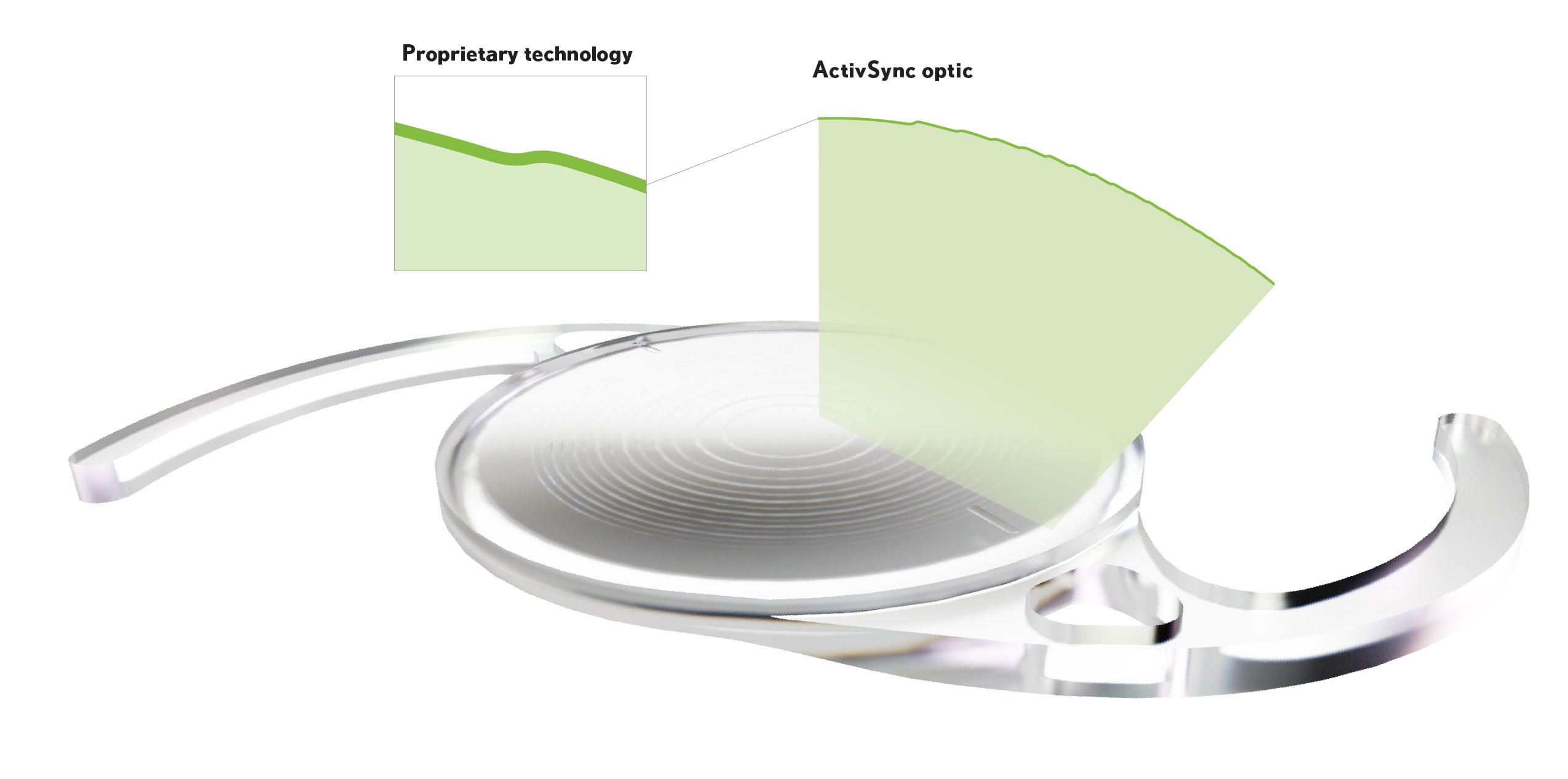
The ActivSync optic of enVista Envy™ delivers intelligent energy distribution to provide patients with enhanced image contrast when they need it most: evenly distributing light in photopic conditions and prioritizing distance in mesopic conditions.
In photopic conditions, ActivSync optic helps maintain functional vision across key viewing distances.1,4


enVista Envy™ US Clinical Study, binocular implantation, 6-month post-op, n=42 eyes
Engineered to Support Quality of Vision
In addition to ActivSync optic, enVista Envy™is enhanced with proprietary technology designed to reduce light scattering, supporting the optical performance surgeons expect from the enVista platform.4
INTERESTED IN LEARNING MORE ABOUT ENVISTA ENVY™?
enVista Envy™ Toric
enVista Envy™ Toric extends the full range of vision platform to astigmatic patients, addressing presbyopia and astigmatism within a single IOL family and making spectacle independence achievable.
Treat More Astigmatic Patients with More Precision5
enVista Envy™ Toric offers a broad cylinder treatment range, including half-step cylinder options, to help surgeons address more astigmatic patients with greater planning precision.5
Lowest available cylinder treatment*
1.25 D at IOL plane (<1 D at corneal plane)
Highest available cylinder treatment*
5.75 D at IOL plane
Only toric platform that treats half-step cylinders
(up to 3.5 D at IOL plane)
*Compared to other multifocal IOL toric platforms approved in the US

enVista Envy™ Toric offers cylinder treatment from 1.25 D to 5.75 D at the IOL plane, including half-step cylinder options up to 3.5 D.5
Correcting presbyopia and astigmatism. BOTH at the same time.
enVista Envy™ Toric combines full range vision correction with astigmatism management in one platform.
Designed for Rotational Stability
The enVista toric platform delivers proven rotational stability through 180 days post-surgery4*
Benefits of Toric IOLs
- Reduces the need for additional refractive correction procedures.
- Provides greater accuracy and range than corneal-incisional and limbal-relaxing procedures.8
Toric alignment and rotational stability are vital for patient satisfaction and visual outcomes. The enVista platform is tailored to deliver exceptionally reliable rotational stability for precise astigmatism correction.
In a U.S. clinical study, 94.4% of eyes showed ≤5° rotation at 180 days post-surgery.4

Percent of eyes ≤ 5° rotation (n=108)
*enVista Toric MX60ET US Clinical Study
Engineered for Stable Positioning
The enVista toric platform is designed for broad capsular bag contact, supporting lens stability and alignment after implantation.⁴

The enVista toric platform is designed with 110° of capsular bag contact.4
The enVista Toric Calculator: Your Partner in Accuracy
Powered by the advanced Emmetropia Verifying Optical (EVO) formula, the enVista Toric Calculator sets the new standard for predicting spherical equivalence and providing data for low astigmatism cases.18
Explore the Latest From Bausch + Lomb Surgical
References:
- Data on File. enVista Envy™ US Clinical Study.
- Data on File. enVista Envy™ Canadian Clinical Study.
- Alcon AcrySof PanOptix Clinical Study.
- Data on File, Bausch + Lomb.
- enVista Envy™ Toric Directions for Use, Bausch + Lomb.
- Hayashi K, Yoshida M, Igarashi C, Hirata A. Effect of Refractive Astigmatism on All-Distance Acuity in Eyes with a Trifocal Intraocular Lens. American J Ophthalmol. 2021;221: 279-286. doi: 10.1016/j.ajo.2020.07.051.
- Zhang L, Shen W, Shen J, Wang M, Ni S, Guo H, Yang J. Effect of Postoperative Residual Astigmatism on Visual Outcomes After Trifocal Intraocular Lens Implantation. Front Med. 2023; 10:1202793 doi: 10.3389/fmed.2023.1202793.
- Lake JC, Victor G, Clare G, et al. Toric intraocular lens versus limbal relaxing incisions for corneal astigmatism after phacoemulsification. Cochrane Database Syst Rev. 2019;12(12):CD012801. doi: 10.1002/14651858. CD012801.pub2.
- Miller AD, Kris MJ, Griffiths AC. Effect of small focal errors on vision. Optom Vis Sci. 1997;74(7):521-526.
- enVista Toric Directions for Use, Bausch + Lomb.
- Wiley WF. Rotational stability of aberration neutral hydrophobic toric IOL with enhanced delivery characteristics. Presented at: ASCRS Annual Meeting; April 22-26, 2022; Washington, D.C.
- enVista Envy™ Directions for Use, Bausch + Lomb.
- Clareon PanOptix Directions for Use, Alcon.
- TECNIS Odyssey Directions for Use, Johnson & Johnson.
- Novis C. Astigmatism and Toric Intraocular Lenses. Current Opinion in Ophthalmology 2000; Vol. 11, Issue 1: 47-50.
- Bozukova D, Pagnoulle C, Jérôme C. Biomechanical and optical properties of 2 new hydrophobic platforms for intraocular lenses. J Cataract Refract Surg. 2013;39(9):1404-1414.
- Whitman j. Comparative assessment of radial compression forces exerted by various hydrophobic acrylic toric IOLs. Caribbean Eye. Cancun, Mexico. 2020.
- Pantanelli SM, Kansara N, Smits G. Predictability of residual postoperative astigmatism after implantation of a toric intraocular lens using two different calculators. Clin Ophthalmol. 2020;14:3627–3634. doi: 10.2147/OPTH.S276285.
- Melles RB, Kane JX, Olsen T, Chang WJ. Update on intraocular lens calculation formulas. Ophthalmol. 2019;126(9):1334-1335.
- Data on file. Blis Inserter.
- Data on file. EyeGility™ Inserter Preloaded IOL Delivery System.
- Shultz MC, Wiley WF, Liang E, Epitropoulos AT, Whitman J. Visual and patient-reported outcomes of a novel full visual range intraocular lens versus a monofocal intraocular lens: a randomized multicenter US trial. Am J Ophthalmol. 2025;280:493-507. doi: 10.1016/j.ajo.2025.08.050.
- Muzychuk A. Harasymowycz P. Efficacy and safety evaluation of a new full visual range versus monofocal intraocular lens in patients with cataract: randomized: controlled Canadian clinical trial. J Cataract Refract Surg. 2025;51(10):867-875. doi:10.1097/j.jcrs.0000000000001714.
- Harasymowycz P, et al. Effect of residual refraction on dysphotopsia and near-vision outcomes in eyes Implanted with a novel full-range-of-vision intraocular lens. Paper presented at: 2025 ASCRS Annual Meeting: April 25-28. 2025: Los Angeles. CA.
- Plauché WB. Early experience with the TECNIS Odyssey and enVista Envy IOLs. Presented at: Caribbean Eye Meeting; 2026. Conference presentation.
- Wong RM, et al. Clinical outcomes and patient experience following IOL exchange to the enVista Envy full visual range IOL. Presented at: 2026 Association for Research in Vision and Ophthalmology Annual Meeting. Conference abstract.
| enVista Envy™ | |
|---|---|
| Model Number | EN (non-preload) |
| Material | Hydrophobic Acrylic |
| Optic Design | One-piece Aspheric, biconvex Anterior apodized diffractive Posterior refractive Posterior aspheric surface 1.6 D intermediate 3.1 D near |
| Optic Size | 6 mm |
| Length | 12.5 mm |
| Optic Edge Design | Sharp 360° square posterior edge |
| Haptics | Modified C, fenestrated |
| Refractive Index | 1.53 at 35° C |
| UV Cutoff | 389 nm at 10% transmittance |
| Optical Biometry Optical A-Constant* ACD Surgeon Factor |
119.5 5.84 mm 2.06 mm |
| Applanation Biometry Applanation A-constant* ACD Surgeon Factor |
119.2 5.60mm 1.89mm |
| Other Features | Glistening free |
| Diopter Range | +6 D to +10 D (1.0 D increments) +10 D to +34 D (0.5 D increments) |
| enVista Envy™ Toric | |
|---|---|
| Model Number | ETN (non-preload) |
| Material | Hydrophobic Acrylic |
| Optic Design | One-piece Aspheric, biconvex Anterior apodized diffractive Posterior refractive Posterior toricity 1.6 D intermediate 3.1 D near |
| Optic Size | 6 mm |
| Length | 12.5 mm |
| Optic Edge Design | Sharp 360° square posterior edge |
| Haptics | Modified C, fenestrated |
| Refractive Index | 1.53 at 35° C |
| UV Cutoff | 389 nm at 10% transmittance |
| Optical Biometry Optical A-Constant* ACD Surgeon Factor |
119.5 5.84 mm 2.06 mm |
| Applanation Biometry Applanation A-constant* ACD Surgeon Factor |
119.2 5.60 mm 1.89 mm |
| Other Features | Glistening free |
| Diopter Range | +6 D to +34 D (0.5 D increments) |
* A-constant values are suggested as a guideline. Physicians should calculate lens power based on optimization of their experience and preference with IOL technology
| Cylinder Power | |||||||||
|---|---|---|---|---|---|---|---|---|---|
| IOL Plane | 1.25 | 1.50 | 2.00 | 2.50 | 3.00 | 3.50 | 4.25 | 5.00 | 5.75 |
Frequently Asked Questions about enVista Envy™
1. What is the enVista Envy™ IOL?
enVista Envy™ is a modern, full-range-of-vision trifocal IOL (intraocular lens) for cataract surgery, designed to improve intermediate and near visual acuity while maintaining distance visual acuity comparable to an aspheric monofocal IOL.12 enVista Envy is supported by two robust clinical studies from the US and Canada, with 419 patient subjects enrolled who received bilateral (both eyes) implantation of enVista Envy.1,2
2. Is enVista Envy™ a multifocal or trifocal IOL?
enVista Envy™ is a type of multifocal called a trifocal IOL with an anterior apodized diffractive optic, a 1.6 D intermediate add, and a 3.1 D near add.12
3. What range of vision does enVista Envy™ provide?
In the U.S. clinical study, enVista Envy™ demonstrated 4 D of continuous visual range across distance, intermediate, and near.1
4. Can enVista Envy™ help reduce spectacle dependence?
enVista Envy™ is designed to support spectacle independence across a range of viewing distances. Some patients may still require glasses for certain activities or if unexpected refractive outcomes occur.1,12 In the US clinical study, 94% of patients reported little to no difficulty viewing close objects. 95% of patients reported little to no difficulty reading their computer screen and 91% of patients reported little to no difficulty reading their mobile screen.1
5. How does enVista Envy™ perform in low-light conditions?
ActivSync optic is designed to prioritize light energy toward distance in larger-pupil conditions, supporting low-light visual clarity. enVista Envy is different than many other trifocals in that it is pupil dependent, adjusting light energy distribution to common focal points during changing lighting conditions.4 In the Canadian clinical study, 84% of patients reported little to no difficulty seeing close objects in poor or dim lit environments.2 As with other trifocal IOLs, some patients may experience reduced contrast sensitivity compared with a monofocal IOL.1,4,12
6. How does ActivSync optic manage light distribution?
ActivSync optic is designed to distribute light evenly in photopic (well lit) conditions across the distance, intermediate, and near focal points and prioritize distance energy in mesopic (poor lit) conditions.4 enVista Envy is different than many other trifocals in that it is pupil dependent.4 ActivSync is designed to manage light distribution in this manner by utilizing an apodized diffractive optic. Apodization means that the diffractive steps are not a uniformed height, but steeper centrally and then become smaller as they move towards to periphery of the lens. Apodization manages near power more centrally in the optic.4
7. How does enVista Envy™ address contrast and light scatter?
ActivSync optic is designed with additional proprietary technology to smooth of soften the transition areas between each diffractive step to reduce light scattering.4 enVista Envy is also designed with -0.15 nm SA (spherical aberration) to enhance image contrast while using diffractive optics (light splitting) to achieve a full visual range.4
8. What visual disturbances should be discussed with patients?
As with most advanced lenses for cataract surgery, patients may experience halos, starbursts, glare or other visual disturbances, particularly under low-light conditions.12 In the US and Canadian enVista Envy clinical studies, most patients reported little to no bothersomeness for glare, halo, and starbursts.1,2
9. What did patients report about glare, halos, and starbursts?
Across the U.S. and Canadian clinical studies, most patients reported little to no bothersomeness from glare, halos, and starbursts at 4 to 6 months after surgery.1,2 For those that reported bothersomeness, 6% or less of patients reported bothersomeness as severe.1,2
10. How satisfied were patients with enVista Envy™ ?
In the Canadian clinical study, 93% of patients reported being moderately to completely satisfied with their vision at 4 to 6 months after bilateral implantation.2
11. Which patients may be appropriate candidates for enVista Envy™ ?
enVista Envy™ may be considered for adult cataract patients seeking improved intermediate and near vision in addition to distance vision. Patient selection should account for ocular health, refractive goals, visual priorities, and tolerance for potential visual disturbances.12 enVista Envy corrects presbyopia and enVista enVista Envy Toric corrects both presbyopia and astigmatism.4
12. Is enVista Envy™ available for patients with astigmatism?
Yes. enVista Envy™ Toric is indicated to correct aphakia and corneal astigmatism while improving intermediate and near visual acuity and maintaining comparable distance visual acuity to an aspheric monofocal IOL.5 Astigmatism is a common condition in which your cornea (front part of the eyeball) isn’t completely round, causing vision to seem blurry or distorted without corrective lenses. In the United States, enVista Envy can treat the widest range of corneal astigmatism in a full visual range toric IOL.4
13. What cylinder powers are available with enVista Envy™ Toric?
enVista Envy™ Toric is available from 1.25 D through 5.75 D at the IOL plane, including half-step cylinder options up to 3.50 D.5
14. What supports rotational stability with the enVista toric platform?
The enVista toric platform features modified C-loop fenestrated haptics and 110° of capsular bag contact. In the enVista Toric MX60ET U.S. clinical study, 94.4% of eyes demonstrated 5° or less of rotation through 180 days.4 Rotational stability in an IOL, especially a toric lens, is important to lock in the astigmatism correction of the IOL to reduce as much post-surgical residual astigmatism as possible. Achieving low residual astigmatism provides a greater chance of quality visual contrast for a patient after cataract surgery.
15. What delivery options are available for surgeons implanting enVista Envy™?
Surgeons may choose the reusable BLIS® system or single-use, preloaded EyeGility system. BLIS supports 2.2–2.4 mm incisions, while EyeGility supports 2.4 mm incisions and uses a silicone soft tip for consistent lens folding and delivery into the capsular bag.20,21
16. How does enVista Envy™ compare with other multifocal or trifocal IOLs?
IOL selection should be based on the patient’s visual priorities, ocular health, tolerance for potential dysphotopsias, astigmatism, and refractive target. enVista Envy™ offers full-range vision, ActivSync light distribution, and toric options across a broad cylinder range to correct astigmatism.1,4,5
17. What should surgeons consider when comparing presbyopia-correcting IOLs for low-light vision and contrast sensitivity?
Consider light-distribution strategy, pupil-dependent performance, contrast sensitivity, and the potential for nighttime visual disturbances. ActivSync optic evenly distributes light in photopic conditions and prioritizes distance energy in mesopic conditions. As with other trifocal IOLs, some patients may experience reduced contrast sensitivity compared with a monofocal IOL.4,12
18. What clinical evidence supports enVista Envy™?
The enVista Envy™ U.S. clinical program included a multicenter, randomized, controlled study with a one-year follow-up period with 332 patient subjects enrolled that received bilateral enVista Envy. Reported outcomes included distance, intermediate, and near visual acuity, continuous visual range, patient-reported dysphotopsia, and safety.1
19. Does enVista Envy™ provide continuous vision from distance through near?
Yes. Clinical studies reported a continuous range of vision from distance through near. Binocular visual acuity was 0.09 logMAR or better, approximately 20/25, from distance through −2.50 D.22,23
20. What patient-reported near-vision outcomes were observed with enVista Envy™?
In the Canadian clinical study, more than 90% of patients reported satisfaction with near vision and little to no difficulty performing near tasks without spectacles.23
21. How did enVista Envy™compare with a monofocal IOL at distance, intermediate, and near?
In a randomized U.S. trial, enVista Envy™provided superior monocular distance-corrected intermediate and near visual acuity, with distance visual acuity comparable to the enVista monofocal IOL.22
22. What contrast sensitivity and dysphotopsia outcomes were reported with enVista Envy™?
Clinical data reported good contrast sensitivity, a favorable dysphotopsia profile, and high patient satisfaction.22,26 Individual experiences may vary.
23. How can residual refractive error affect enVista Envy™ outcomes?
An analysis presented at ASCRS 2025 reported comparable near visual acuity and dysphotopsia outcomes between plano and non-plano groups. Achieving emmetropia remained associated with a greater likelihood of near-vision satisfaction.24
24. What have real-world data shown following enVista Envy™ implantation?
Early real-world data reported refractive accuracy and visual performance across distance, intermediate, and near. No glistenings or serious adverse events were reported in the evaluated population.25
25. Can enVista Envy™ be considered following an IOL exchange for persistent visual disturbances?
In a small case series, patients undergoing exchange from previously implanted IOLs (including other full visual range IOLs) to enVista Envy™ reported resolution of identified visual disturbances, good visual outcomes, and satisfaction with the replacement lens.26 Results from a case series may not be representative of broader patient populations.
References:
12. enVista Envy Directions for Use, Bausch & Lomb.
1. Data on File. enVista Envy US Clinical Study.
4. Data on File, Bausch+Lomb.
2. Data on File. enVista Envy Canadian Clinical Study.
5. enVista Envy Toric Directions for Use, Bausch & Lomb.
20. Data on file. Blis Inserter.
21. Data on file. EyeGility™ Inserter Preloaded IOL Delivery System.
22. Shultz MC, Wiley WF, Liang E, Epitropoulos AT, Whitman J. Visual and patient-reported outcomes of a novel full visual range intraocular lens versus a monofocal intraocular lens: a randomized multicenter US trial. Am J Ophthalmol. 2025;280:493–507. doi:10.1016/j.ajo.2025.08.050.
23. Muzychuk A, Harasymowycz P. Efficacy and safety evaluation of a new full visual range versus monofocal intraocular lens in patients with cataract: randomized, controlled Canadian clinical trial. J Cataract Refract Surg. 2025;51(10):867–875. doi:10.1097/j.jcrs.0000000000001714.
24. Harasymowycz P, et al. Effect of residual refraction on dysphotopsia and near-vision outcomes in eyes implanted with a novel full-range-of-vision intraocular lens. Paper presented at: 2025 ASCRS Annual Meeting; April 25–28, 2025; Los Angeles, CA.
25. Plauché WB. Early experience with the TECNIS Odyssey and enVista Envy IOLs. Presented at: Caribbean Eye Meeting; 2026. Conference presentation.
26. Wong RM, et al. Clinical outcomes and patient experience following IOL exchange to the enVista Envy full visual range IOL. Presented at: 2026 Association for Research in Vision and Ophthalmology Annual Meeting. Conference abstract.
-
Media
Title
Tag
-

BLIS® enVista Envy Loading Guide
Marketing Brochures enVista EnvyMarketing Brochures enVista Envy -
enVista Envy Features and Specifications
Marketing Brochures enVista EnvyMarketing Brochures enVista Envy -

IOL+OVD Product Catalog
Catalogs enVista Envy enVista enVista AspireCatalogs enVista Envy enVista enVista Aspire -

INJ100 enVista Envy Loading Guide
Marketing Brochures enVista EnvyMarketing Brochures enVista Envy -
enVista Envy Surgeon Brochure
Marketing Brochures enVista EnvyMarketing Brochures enVista Envy -
enVista Envy™ Toric Features and Specifications
Marketing Brochures enVista EnvyMarketing Brochures enVista Envy -

enVista Envy™ Patient Brochure: Espanol
En españolMarketing Brochures enVista EnvyMarketing Brochures enVista Envy -
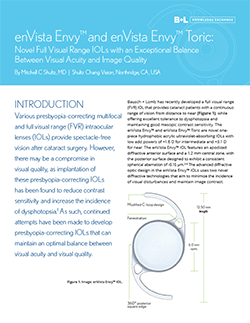
enVista Envy™ and enVista Envy™ Toric: Novel Full Visual Range IOLs with an Exceptional Balance Between Visual Acuity and Image Quality
Marketing Brochures enVista EnvyMarketing Brochures enVista Envy -

enVista Envy Patient Brochure: English
Marketing Brochures enVista EnvyMarketing Brochures enVista Envy
-
Media
Title
Tag
-
enVista® Platform Technologies
Product Features enVista enVista Aspire enVista EnvyProduct Features enVista enVista Aspire enVista Envy -
Patient Testimonial: Wonderful Experience with enVista Envy™
Patient Videos enVista EnvyPatient Videos enVista Envy -
Patient Testimonial: Seeing Clearly with enVista Envy™
Patient Videos enVista EnvyPatient Videos enVista Envy -
Patient Testimonial: Renewed Experiences with enVista Envy™
Patient Videos enVista EnvyPatient Videos enVista Envy -
Real World Outcomes with enVista Envy: Dr. Alice Epitropolous
Peer Opinions enVista EnvyPeer Opinions enVista Envy


